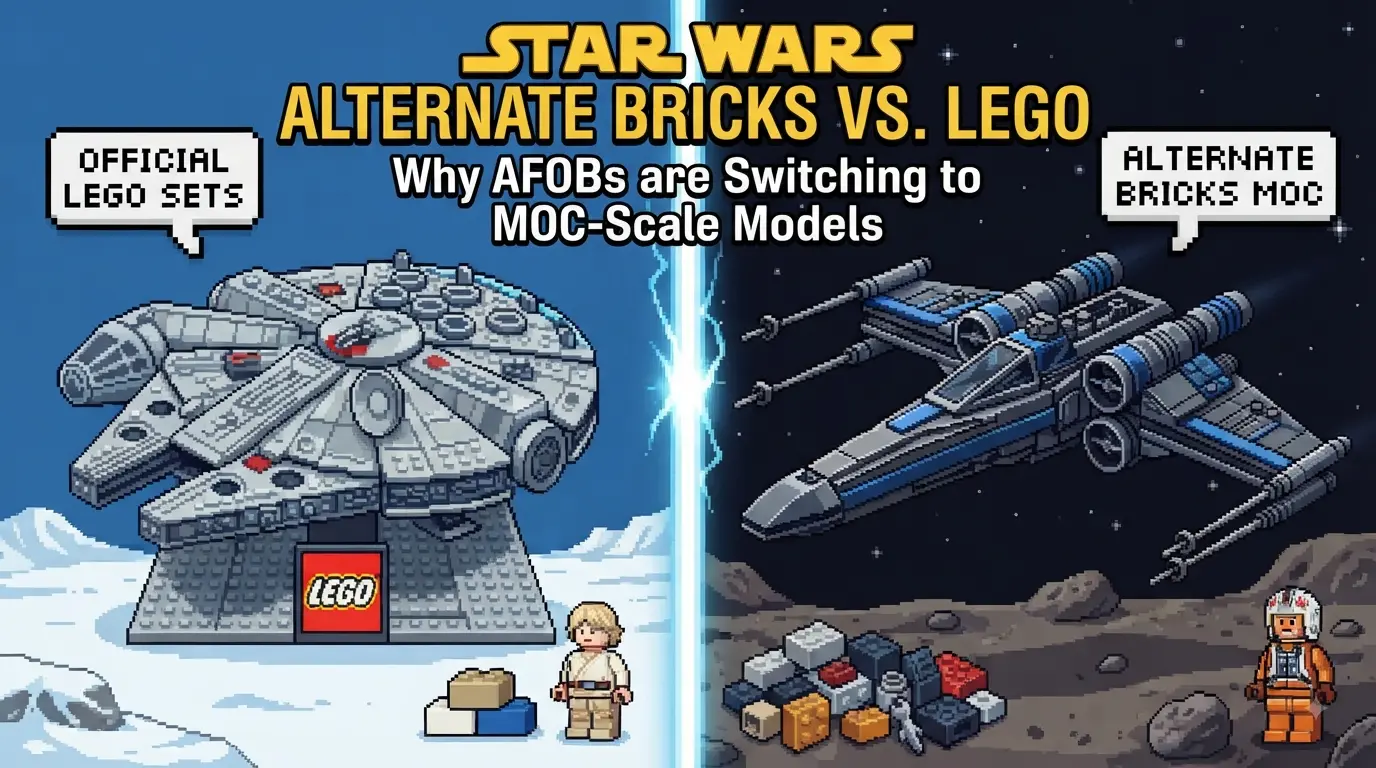
The question of why is LEGO Star Wars so expensive has pushed a growing community of adult builders toward a sophisticated alternative market one that looks nothing like the cheap knock-offs of a decade ago. Before comparing specific sets and brands, you need a working vocabulary for this space.
AFOB (Adult Fan of Bricks)
Adult builders who prioritize technical complexity, display quality, and scale over play features. This demographic drives demand for large scale Star Wars brick sets 7,000 pieces and above, where retail options are scarce and pricing is prohibitive.
GoBricks
The dominant raw-component manufacturer supplying the premium end of the alternate brick market. According to independent clutch-power testing, GoBricks components meet or exceed the tolerances of market leaders, and the manufacturer serves as the primary supplier for high-end brands focused on color uniformity and consistent stud grip.
MOC (My Own Creation)
A custom design built outside any official set typically engineered by independent designers and sold as instruction packages or licensed kits. MOC-scale builds routinely exceed 3,000 pieces and prioritize accuracy over retail-friendly part counts.
Clutch Power
The measurable friction force between a stud and a tube. It determines whether a finished model holds its shape under handling. Low clutch power is the primary failure point of genuinely poor-quality bricks.
The Lepin stigma — earned by a manufacturer that directly copied LEGO molds and sold counterfeit sets still colors how newcomers perceive the entire alternate market. But modern brands building on GoBricks components occupy a fundamentally different category: original designs, licensed instructions, and consistent part quality that independent reviewers consistently validate.
Understanding these distinctions is the foundation for a fair comparison. The next section puts specific sets and brands side by side on the metrics that actually matter to AFOBs price per piece, part count ceilings, and design complexity.
Before evaluating any alternate brand, confirm it sources components from a verified manufacturer with published clutch-power data.
Head-to-Head: LEGO Star Wars vs. Leading Alternatives
As the previous section established, adult fans of bricks (AFOBs) are no longer treating alternative brick brands as a compromise. For many, they have become the primary choice particularly when evaluated against hard data on pricing and scale. Whether you are hunting for the best LEGO Star Wars alternatives for adults or simply trying to stretch a display budget further, the numbers make a compelling case.
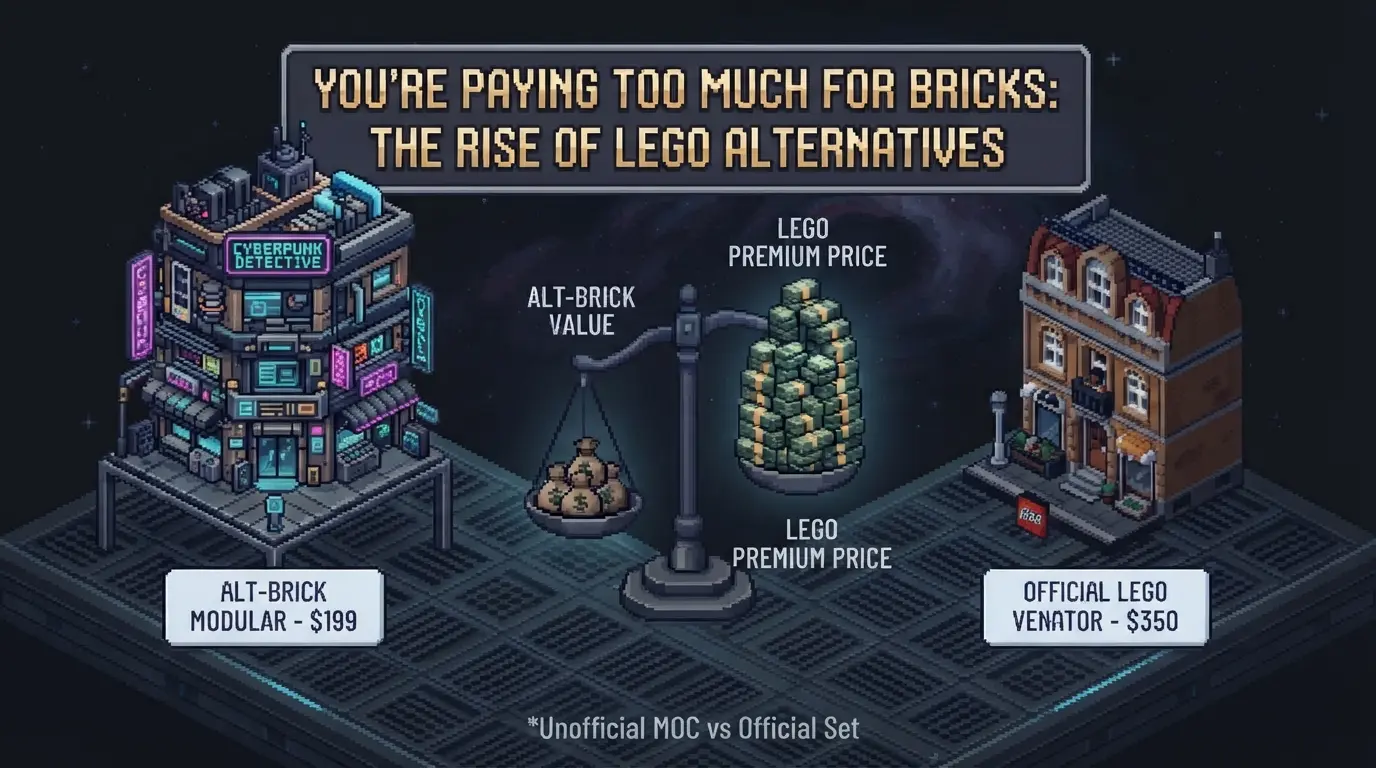
Alternative brick sets typically cost 50% to 75% less per piece than official LEGO Star Wars sets, according to BrickFact. And when it comes to large-scale builds, alternative brands offer up to 400% more Master Builder-level sets (5,000+ pieces) in the sci-fi category compared to the official LEGO catalog, per the Alt-Brick Database.
The table below breaks down the key decision variables side by side:
LEGO-compatible; clutch power debated (see GoBricks vs LEGO clutch power comparisons)
| Feature | LEGO Star Wars | Alt-Brick Brands |
|---|---|---|
| Avg. Price Per Piece | $0.11–$0.17 | $0.03–$0.07 |
| Max Set Size Available | ~5,400 pieces (UCS Millennium Falcon) | 7,000–11,000+ pieces (MOC-scale cruisers) |
| Licensing Fee Impact | Estimated 20–30% premium baked into retail price | None no IP licensing costs passed to buyer |
| Component Sourcing | Proprietary LEGO system only |
Clutch power remains a legitimate discussion point among builders. Community testing documented in videos like this four-brand comparison shows that leading alternative manufacturers have narrowed the gap considerably, though LEGO’s tolerance consistency remains a benchmark. In practice, the GoBricks vs LEGO clutch power debate matters most on structural builds display-focused models with internal framing tend to perform well regardless of brand.
MOC-scale complexity is where alternative brands pull decisively ahead. Without retail packaging constraints or child-safety piece-count limits, independent designers working with alternative manufacturers can engineer details panel layering, greebling density, interior cockpit sections that simply do not exist at LEGO’s retail scale. That structural freedom, combined with the dramatic cost-per-piece advantage, is what the next section will examine in full: how 7,000-piece cruisers and flagship MOC designs are redefining what a Star Wars display can actually look like.
If price-per-piece efficiency and display scale are your priorities, the data strongly favors exploring alternative brick brands over waiting for official UCS releases.
Why Alt-Bricks Win for Large-Scale Star Wars Displays
When comparing star wars alternate bricks vs lego price per piece, the gap goes far beyond raw cost. It reflects a fundamental structural difference between a retail toy company and a community-driven builder ecosystem and for adult fans who want true display-scale Star Wars models, that difference is decisive.
Retail Constraints Keep LEGO Sets Small
LEGO’s production pipeline must satisfy retail safety certifications, box size standards, and mass-market price thresholds. In practice, those requirements place a hard ceiling on set complexity. The company releases only one or two Ultimate Collector Series sets per year, each demanding years of internal approval cycles. As Custom Bricks Design Journal notes, “The variety of Star Wars-inspired MOC designs available from alternative brands offers a level of scale and detail that LEGO’s commercial constraints cannot match.” By contrast, according to the Alt-Brick Database, the combined annual output of leading alternative manufacturers provides dozens of massive-scale cruisers that LEGO’s pipeline could never match. Key takeaway: Retail infrastructure, not engineering skill, limits LEGO’s ceiling.
Designer Partnerships Unlock True MOC Scale
Alternative brands actively license designs from independent AFOB designers the same community members who once built for passion alone. This partnership model means MOC scale Star Wars cruisers with 7,000-plus pieces reach production without a corporate committee filtering out ambition. A 7,000-piece Star Destroyer commands a display shelf in a way that a 4,700-piece retail equivalent simply cannot.
The Licensing Tax
LEGO’s Star Wars agreement with Lucasfilm carries an estimated 20–30% cost premium baked into every set’s retail price. That premium funds IP rights, not better plastic or engineering. On a $700 set, you are effectively paying $210 for a logo. Alternative brands operate outside that agreement, redirecting cost into piece count and structural density instead.
However, licensing also delivers something real: official minifigures and resale value that alternatives cannot replicate a tradeoff worth examining closely as you weigh your final decision.
The clearest argument for alternative bricks is not price alone, but the freedom that absence of licensing and retail constraints provides to build at genuine display scale.
| Option | Avg. Price Per Piece | Max Piece Count (typical) | Best For |
|---|---|---|---|
| LEGO Star Wars (UCS) | $0.14–$0.18 | ~4,700 pieces | Minifigures, resale value, brand prestige |
| Alt-Brick MOC Sets | $0.04–$0.07 | 7,000–10,000+ pieces | Display scale, budget builds, designer MOC accuracy |
Pick LEGO if minifigure authenticity and long-term resale matter to your collection. Pick alt-brick MOC sets if maximum visual impact per dollar is the goal which is exactly the scenario the next section breaks down in full.
The Bottom Line: When to Choose Alternatives
The ongoing debate around mould king star wars vs lego quality does not have a single answer it has a context-dependent one. Both camps serve real needs, and the smartest builders are those who match the tool to the goal rather than pledging loyalty to one brand.
| Priority | Best Choice | Key Reason | Typical Price Per Piece |
|---|---|---|---|
| Minifigures & Resale Value | LEGO | Official licensing, collector demand, secondary market liquidity | $0.10–$0.13 |
| Large-Scale Display Builds | Alt-Brick Brands | MOC-scale piece counts at dramatically lower cost | $0.03–$0.05 |
| Budget-Conscious Collectors | Alt-Brick Brands | Stretch the ssame dollar across 2–3x more star wars bricks | $0.03–$0.05 |
| Gift-Giving & Brand Recognition | LEGO | Universal recognition, warranty, consistent part tolerances | $0.10–$0.13 |
According to BrickFact, LEGO Star Wars sets average $0.10–$0.13 per piece while leading alternatives land at $0.03–$0.05 a gap that compounds quickly once your build crosses the 3,000-piece threshold.
Key Takeaways:
- Resale and minifigures still favor LEGO — official sets hold secondary market value that alt-brick products simply cannot replicate.
- Scale and budget favor alternatives — for display-focused MOCs, the cost savings are structural, not marginal.
- Quality concerns are narrowing — the Mould King Star Wars vs LEGO quality gap has closed meaningfully at the premium alt-brick tier, as independent build reviews consistently confirm.
- Hybrid strategies work — many AFOBs source official LEGO minifigures while populating large dioramas with alt-brick structures to balance authenticity and affordability.
The verdict on “Are they worth it?” is a clear yes with one condition: define your goal before you buy. If you are building for display scale, alt-brick brands deliver more star wars bricks per dollar than any official set can justify. If you are building for resale or gifting, LEGO remains the standard. Ready to plan your next large-scale build? Explore high-piece-count Star Wars sets across both categories and let your display space and your budget make the final call.
Choose your brick source based on build purpose, not brand habit and your next large-scale Star Wars display will reward that discipline.